

Fed Inflation and the Collapse of Purchasing Power Why Currencies and Empires Fall
- lhof39
- 6 days ago
- 10 min read
A currency does not usually fail in one dramatic scene. It weakens at the supermarket, at the fuel pump, in rent payments, in school fees, and in the quiet shock of seeing last year’s savings buy less this year.
That is the real face of inflation. It is not an abstract chart. It is a transfer of purchasing power away from ordinary people. It rewards those closest to new money and punishes those who earn wages, save cash, live on fixed income, or try to plan beyond the next few months.
The Federal Reserve presents inflation as something to be managed. A little inflation is treated as normal, even healthy. Rates are raised, cut, paused, and discussed in careful language. Yet the deeper issue remains. The system has accepted a steady loss of purchasing power as the price of keeping debt-heavy markets, banks, and government spending afloat.
That choice has consequences. History shows that when money loses credibility, public trust follows. When public trust fails, regimes become fragile. Empires do not collapse only because of armies at the border. They also collapse when their money stops telling the truth.

The Fed has normalised the loss of purchasing power
The Federal Reserve was created to stabilise the financial system. Over time, it has become the institution most associated with managing credit, interest rates, liquidity, and inflation expectations in the United States.
Its defenders argue that the Fed prevents panics, supports employment, and smooths out recessions. In moments of crisis, it can inject liquidity fast. It can calm markets. It can lower borrowing costs when private credit freezes.
But the price of this model is clear: the dollar has lost a vast share of its purchasing power over the past century.
A dollar today buys only a small fraction of what it bought when the Federal Reserve was founded in 1913. The exact comparison depends on the index used, but the direction is not in dispute. The trend has been relentless. Long-term holders of cash have been punished. Wage earners have needed constant nominal raises just to stay in place.
That is not stability in any meaningful sense. It is controlled erosion.
When a central bank targets positive inflation, it is saying prices should rise over time. The public is trained to accept that money should steadily lose value. This creates a strange moral inversion. Saving becomes risky. Borrowing becomes normal. Speculation becomes rational. Debt becomes policy.
The phrase Central bank creating inflation sounds blunt, but it captures the core complaint. When the supply of money and credit expands faster than real goods and services, purchasing power suffers. That may happen through emergency programmes, rate suppression, asset purchases, or the long habit of rescuing highly indebted systems from the consequences of their own excess.
The Fed does not act alone. Congress spends. The Treasury borrows. Banks lend. Markets demand rescue. But the Fed gives the system its escape valve. When debt becomes too large, inflation offers a political way out. It reduces the real value of debt without an open default.
That may help governments and debtors. It hurts the public.
Inflation is not just higher prices
People often describe inflation as prices going up. That is only the visible part.
The more accurate view is that the currency buys less. The loaf of bread did not suddenly become more magical. The rent payment did not become more noble. The fuel did not become more meaningful. The measuring stick changed.
When money loses value, society starts to behave differently.
Families buy sooner because waiting means paying more. Workers demand higher wages because last year’s pay no longer works. Businesses raise prices not only because costs rose, but because they expect costs to keep rising. Landlords, insurers, schools, and service providers build future inflation into today’s pricing.
This creates a feedback loop. The public loses confidence in the future value of money. That loss of confidence changes behaviour. That behaviour then feeds the next round of price increases.
Inflation also hides taxation. A government can raise taxes and face public anger. It can borrow and face debate. Or it can benefit from inflation, which reduces the real value of what it owes and pushes people into higher nominal income brackets. The pain spreads, but the cause feels distant.
That is why inflation is politically useful. It is indirect. It blurs responsibility.
A worker may blame the shop. The shop may blame suppliers. Suppliers may blame transport, energy, wages, and credit costs. Each link has a real complaint. Yet behind the chain sits the monetary environment that made everyone price in uncertainty.
Inflation is a tax that does not need a tax bill.

The Fed chooses the system over the saver
The Fed’s choices often reveal its priorities. When markets crack, credit tightens, or large financial institutions come under stress, policy moves quickly. Rates fall. Liquidity facilities appear. Asset purchases expand. New language enters the public debate.
When savers suffer, the reaction is slower.
For years, low interest rates punished people who kept money in bank accounts. Retirees searching for yield were pushed into riskier assets. Young people trying to save for homes watched asset prices rise faster than wages. Anyone holding cash lost purchasing power while financial markets often cheered easy money.
This is one of the most damaging social effects of modern monetary policy. It divides the country between those who own assets and those who rely mainly on income.
Asset owners may benefit when cheap money lifts property, equities, and other financial instruments. Wage earners face the other side of the ledger, higher living costs and unstable long-term planning. The result is not only economic pressure. It is political anger.
That is why slogans such as “end the FED” and “audit the fed” gain force whenever inflation and loss of purchasing power become daily experience. People sense that the rules favour institutions over households. They see bailouts for the connected and lectures on discipline for everyone else.
The Fed may describe its actions as technical. But money is never only technical. It is social. It is political. It shapes who gains, who loses, who waits, and who gets rescued.
Common sense policies would begin with a different assumption: money should hold value. A society should not need constant asset inflation to feel prosperous. A family should not have to become a speculator to preserve its savings. A government should not rely on currency debasement to manage promises it cannot honestly fund.
Sound money does not solve every problem. It does not build houses, train workers, or prevent every recession. But it does create a harder budget constraint. It forces honesty sooner. That is exactly why political systems resist it.
Currency decay is a warning sign of regime decay
The collapse of purchasing power is not only an economic event. It is often a political warning.
When a regime can no longer fund itself through honest taxation or sustainable borrowing, it is tempted to use the currency. This may begin quietly. A coin contains less precious metal. A note is printed in greater volume. A central bank expands its balance sheet. Accounting language hides the scale of the problem.
The Roman Empire offers a famous example. Over time, some emperors reduced the silver content of coins to stretch state finances. Military costs, bureaucracy, political instability, and external pressure all played roles. Currency debasement was not the only cause of decline, but it reflected a state under strain.
The same pattern has appeared in different forms across history. When governments face impossible promises, they reach for money creation. When citizens notice, trust breaks. Once trust breaks, the state must use more force, more propaganda, more capital controls, or more external conflict to maintain order.
Money depends on belief. A banknote has value because people trust that others will accept it tomorrow. A government bond has value because investors trust future repayment in meaningful currency. A pension promise has value because workers trust the system that backs it.
When that trust fades, citizens look for exits. They buy hard assets. They seek foreign currency. They move capital offshore where possible. They barter. They distrust official numbers. They treat government assurances as theatre.
At that stage, the problem becomes more than inflation. It becomes legitimacy.

Empires fall when promises outrun reality
Empires tend to believe they are exceptions. Their leaders assume the rules that ruined others do not apply to them. Their currencies dominate trade. Their armies project power. Their institutions look permanent. Their elites confuse habit with destiny.
Then costs rise.
Military commitments spread across regions. Welfare promises expand at home. Debt grows. Political factions use spending to buy loyalty. Productive capacity weakens. The public becomes harder to satisfy because previous promises set expectations that cannot be met honestly.
At first, the empire borrows. Later, it manipulates money. Near the end, it must choose between default, austerity, taxation, repression, or inflation. Inflation is often the easiest political choice because it delays the confrontation.
But delay is not escape.
A currency can absorb abuse for a long time if the issuing power remains strong. The US dollar still benefits from deep capital markets, global trade use, military reach, and a lack of easy alternatives. That strength is real. It should not be dismissed.
Yet reserve currency status is not a divine right. It is earned through trust, rule of law, productive strength, and credible policy. If those weaken, the status weakens too. Slowly at first. Then quickly when confidence changes.
The danger is not that the dollar disappears overnight. The danger is that Americans and dollar users worldwide keep losing purchasing power while leaders pretend the system is healthy. The danger is that policy makers treat symptoms with more of the disease.
Debt crisis? Add liquidity.
Market panic? Cut rates.
Weak growth? Expand credit.
Political pressure? Avoid pain today and push costs into tomorrow.
That pattern is not strength. It is dependency.
Financial collapse often brings violence and war
Economic breakdown does not guarantee war in every case. History is too complex for simple formulas. But severe currency collapse often appears near periods of unrest, violence, authoritarian politics, or war.
This happens because money connects everything. When money fails, contracts fail. Savings fail. Wages fail. Public budgets fail. Police, soldiers, pensioners, and civil servants all become part of the crisis. Groups fight over what remains.
Leaders under pressure may also search for external enemies. War can distract from domestic failure. It can justify emergency powers. It can absorb public anger and redirect blame. It can also be the result of resource stress, broken alliances, and collapsing state capacity.
The Weimar Republic is one of the clearest warnings. Hyperinflation did not by itself cause everything that followed, but it destroyed middle-class savings and damaged faith in democratic institutions. That trauma fed radical politics. When money becomes absurd, politics often follows.
Other collapses show similar stresses. Currency failure can lead to shortages, black markets, capital flight, riots, crackdowns, and border conflict. People do not remain calm when work loses meaning and savings vanish.
That is why purchasing power matters. It is not a narrow concern for economists. It is one of the foundations of civil peace.
A stable currency allows strangers to cooperate. It allows families to plan. It allows workers to trade time for value with confidence. It allows businesses to invest without guessing the future price level like gamblers.
Destroy that foundation and society becomes more suspicious, more desperate, and more open to extreme solutions.
The strongest argument for the Fed still fails
The best defence of the Fed is simple: without it, crises might be worse. Banks could fail in chains. Credit could freeze. Jobs could vanish faster. Panic could spread through the financial system before elected leaders act.
This argument has weight. Central banking exists because financial panics are real. A purely rigid system can become brittle. Liquidity can disappear even when assets have long-term value. A lender of last resort can stop a panic from becoming a depression.
But this defence avoids the bigger question. How many crises come from the same system the Fed supports?
When credit stays too cheap for too long, debt builds. When investors believe the central bank will rescue markets, risk grows. When government borrowing faces no immediate discipline, spending expands. When banks and funds expect emergency support, moral hazard becomes normal.
The Fed then appears as the firefighter after helping design a town full of dry timber.
A real common sense policy would not pretend pain can be abolished. It would accept that bad debt must clear, failed bets must fail, and prices must tell the truth. It would reward saving rather than punish it. It would make money boring again.
That means:
Clear limits on emergency monetary expansion
More honest accounting of public debt and obligations
Less reliance on low rates to support asset prices
Greater transparency around central bank actions
A serious debate about whether permanent inflation targets serve the public
The public does not need mystical monetary theories to understand the problem. People see it every time they compare paycheques with rent, food, insurance, and school costs.
If the currency weakens year after year, the system is taking something.
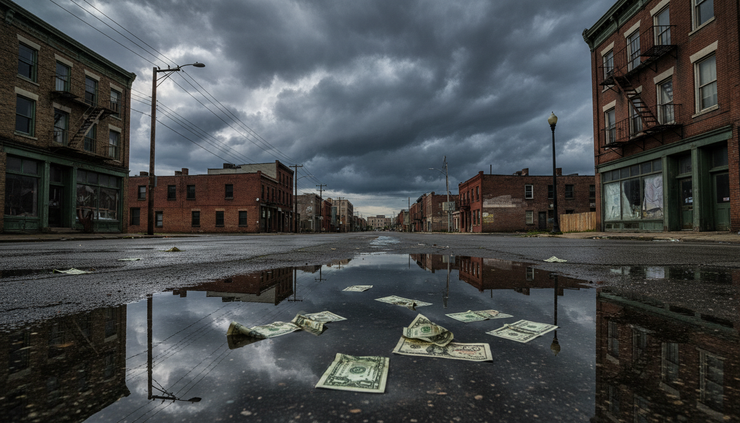
The real choice is honesty or decay
The fall of purchasing power is easy to dismiss when it happens slowly. A few per cent here, a few per cent there, a new normal every year. But slow theft is still theft, even when dressed in policy language.
The Fed and the wider political system have chosen inflation because it is easier than discipline. It is easier than cutting spending. Easier than allowing overvalued assets to reset. Easier than telling voters that promises exceed productive reality. Easier than forcing banks, funds, and governments to live with the consequences of bad decisions.
But currencies do not forgive forever. They keep score.
When money stops preserving value, people stop trusting institutions. When institutions lose trust, regimes become brittle. When regimes become brittle, leaders often reach for control, conflict, and force. That is how monetary decay moves from prices to politics, and from politics to violence.
The lesson from history is plain enough: a society that destroys its money destroys the quiet agreement that holds it together.
The dollar has not collapsed. The United States has not fallen. But the warning signs deserve more than polite central bank language. A currency can remain dominant and still betray the people who use it. An empire can look powerful while hollowing out its foundations.
Purchasing power is the signal. Ignore it long enough, and the bill arrives in forms no central bank can print away. Protect yourself.


Comments